
A wealth declaration is easy to collect and hard to challenge. An applicant states a career, a business, or a figure, and unless that figure is corroborated against a source outside the applicant's own paperwork, it sits in the file as accepted rather than verified. This is the most common gap in CBI applicant due diligence, and it rarely shows up as a missing document. It shows up as a document nobody actually checked.
What Source of Wealth Actually Means
Source of Wealth (SOW) refers to the origin and accumulation of an applicant's overall wealth and assets over time; not a single transaction, but the full picture of how someone's net worth was built. It may arise from employment, business ownership, dividends, investment returns, inheritance, gifts, asset disposals, loans, trusts, or family-office arrangements. The review should establish not only the stated source, but whether the evidence supports the scale, timing, and lawful origin of the wealth claimed.
This is a broader and more demanding question than it first appears. A wealth narrative can be internally plausible, a career history that roughly matches a claimed net worth, while still lacking the independent evidence to actually stand behind it.
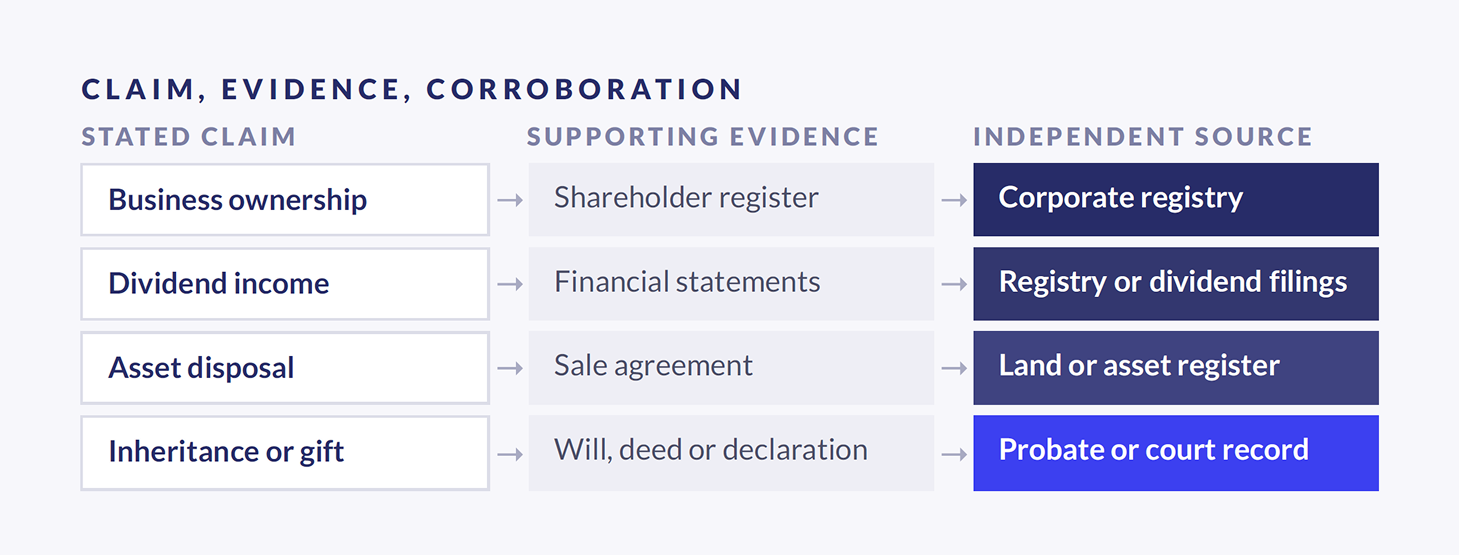
Assessing the Narrative, Not Just Collecting It
An applicant's account of how their wealth was built should be assessed for internal consistency: does the timeline of income-generating activity match the scale of wealth claimed, does their professional background plausibly support the stated earnings, and are there unexplained gaps? Supporting documentation should be assessed for authenticity and consistency and, critically, for whether it actually supports the specific claim being made, rather than simply being present in the file.
Wherever possible, an applicant's own account should be corroborated against sources independent of the applicant: corporate registries confirming ownership and dividend history, public records confirming asset sales, and industry or media sources confirming career activity. This is what separates a verified position from an accepted narrative, and it is where many files stop short.
Source of Wealth Is Not Source of Funds
This is the distinction the Wolfsberg Group's guidance treats as foundational, and it is worth stating plainly: Source of Wealth asks how an applicant's total net worth was built over a career or a lifetime. Source of Funds asks a narrower question: where did the specific money used for this transaction come from?
An applicant can have a well-documented, entirely legitimate source of wealth, while the funds used for a specific transaction still raise separate questions. For example, if they were transferred from a third party, routed through an intermediary jurisdiction, or drawn from an account with limited transaction history. Verifying one does not verify the other, and treating them interchangeably, is one of the more consequential gaps a due diligence file can have.
Tracing Source of Funds to the Transaction
Where Source of Wealth verification looks backwards across a career, Source of Funds verification follows a single transaction forward: from the originating account to the receiving account. The review should establish the account holder, the source and availability of funds before transfer, the transaction path, any intermediary banks or parties, the payment purpose, currency conversion, and whether the payment route complies with relevant institutional requirements.
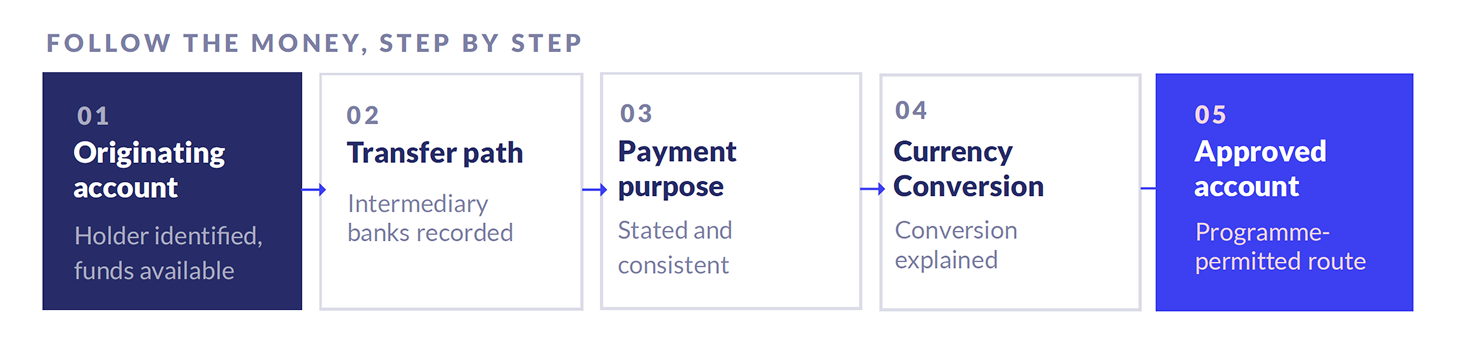
Third-party funding adds a further layer. Where funds originate from someone other than the applicant, the relationship, rationale, and legal basis for the funding should be documented, and the funding party should be identified and screened, with their own Source of Wealth and Source of Funds independently assessed where the risk profile warrants it. Gifts, loans, trust distributions, and corporate payments should be supported by relevant agreements and evidence that the arrangement is genuine, not a means of obscuring the origin or control of funds.
Funds that pass through multiple jurisdictions without a clear commercial rationale, or amounts that do not reconcile with an applicant's documented income, should be treated as matters requiring further investigation, not administrative gaps to be closed with additional paperwork.
Why This Carries Particular Weight in CBI Due Diligence
Citizenship by Investment applicants are, almost by definition, people whose wealth spans more than one jurisdiction and whose transaction history may involve intermediary accounts, family structures, or business entities the applicant does not personally hold. This is precisely the profile where the difference between Source of Wealth and Source of Funds stops being a technical distinction and becomes the actual substance of the risk assessment.
This is the reasoning behind the six-stage due diligence framework Identify, Verify, Screen, Investigate, Assess, Monitor,Monitor where independent corroboration of both wealth and funds sits explicitly inside the Verify stage, rather than being folded into a single identity check.
Applying a Risk-Based Standard
Not every applicant requires the same depth of verification for Source of Wealth or Source of Funds. A risk-based approach, treating a straightforward, well-documented profile differently from one with ambiguity or gaps, is consistent with how due diligence effort should scale generally: proportionate for lower-risk files, targeted where specific claims cannot be corroborated, and extended into enhanced due diligence where the wealth or funds picture remains unresolved after initial review.
Taken together, the two questions are not a compliance formality layered on top of identity verification. They are frequently where the actual risk in an applicant's file resides, and where a defensible due diligence process needs to spend its effort.
Conclusion
Source of wealth and source of funds answer different questions, and a due diligence file that treats them as one question has not actually closed either risk. Source of wealth needs to be independently corroborated against evidence outside the applicant's own account. The source of funds needs to be traced transaction by transaction, from the originating account through to the funds actually received. Neither is resolved by the other, and for applicant profiles that span multiple jurisdictions a defining feature of Citizenship by Investment due diligence the two questions are frequently where a defensible risk assessment either holds up or falls apart.
For a practical framework covering source of wealth corroboration, source of funds tracing, and the point at which a file should move to enhanced due diligence, see Cedar Rose's Citizenship by Investment Due Diligence Guide.
Sources & References
- Wolfsberg Group – FAQs on Source of Wealth and Source of Funds (Private Banking/Wealth Management) (2020, current industry-standard reference)
- FATF – Annual Report 2023–2024, noting corruption linked to investment schemes for citizenship and residency among emerging risk areas (published January 2025)
- Cedar Rose – Citizenship by Investment Due Diligence Guide (2026)