
In the UAE, "without delay" has a number. The Central Bank's rulebook defines it as within 24 hours of the listing decision, and its targeted financial sanctions guidance tells licensed financial institutions that when a confirmed or potential match is found they must freeze or suspend funds or transactions immediately and without prior notice, then report through goAML within five business days.
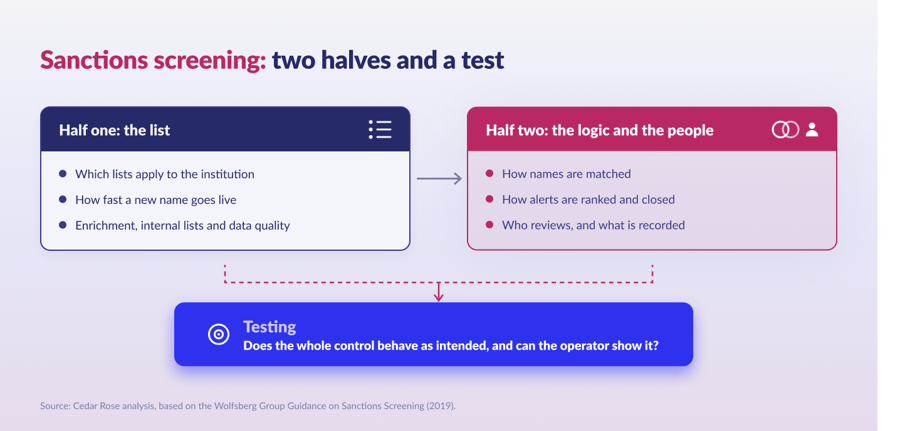
The clock starts at the listing decision, not at the match. That makes the list the first control: a name that reaches the filter late is a name that is screened late. It is also why the list is only half of the control. The other half is what the engine and the analysts do with it, which covers how names are matched, how alerts are ranked and closed, and how anyone knows the whole arrangement behaves as intended.
This article takes the two halves in four steps and frames each as a question a programme operator can put to its own process, because the decisions belong to the operator and not to the screening tool. It does not cover how a sanctions match differs from PEP exposure. Our post on PEP exposure versus a sanctions match and our guide to politically exposed persons cover that. Here the focus is the screening control itself.
What sanctions screening is, and what it is not
Sanctions screening compares text from an institution's own records against lists of sanctioned parties and sanctions-relevant terms, to detect similarities that suggest a possible match. The Wolfsberg Group's guidance on sanctions screening describes the core of it as the comparison of one string of text against another. Most institutions run two controls: customer or name screening, at onboarding and through the life of the relationship, and transaction screening, which checks movements of value before they complete.
An alert is not a finding. Wolfsberg states that generating an alert is not, by itself, an indication of sanctions risk. It is the first step, which additional information then confirms or discounts. Deciding what counts as a true match is harder than it sounds, because names vary by alphabet, language, culture, spelling, abbreviation and alias.
Screening also has limits that belong in every programme document. Wolfsberg says it can never detect every possible sanctions risk, because a string of text can be altered in many ways and still convey the same meaning. Its effectiveness varies between institutions even where they use the same vendor product.
Half one: the list
The list decides what the filter can find. Wolfsberg treats list management as an end-to-end process covering selection, sourcing, maintenance, enrichment, whitelisting, geographic scope and the choice between exact and fuzzy matching for each list. Selection is driven by legal obligation and risk. A global institution may prohibit dealing with any party sanctioned by the US, the UN, the EU or its home country. A smaller institution operating in one country may limit its policy to that country's sanctions laws.
In the UAE the mandatory targeted financial sanctions lists are the UAE Local Terrorist List and the UN Security Council Consolidated List, under Cabinet Decision No. 74 of 2020. UAE guidance, as summarised by RegLex Global Consulting, treats those two lists as the scope of the targeted financial sanctions duties, and says a match on another list such as OFAC, the EU or the UK is not reported as a confirmed or partial name match. Which lists bind an institution in each MEA market is a legal question first and a data question second, and whether to screen further lists is a matter of the institution's own legal exposure and policy, which the operator decides and records.
Currency is the second test. Wolfsberg says lists must be accurate, reliable, up to date and refreshed frequently, and that when new designations are published the priority is to get the names into screening as quickly and accurately as possible. It points to the delay between a regulator's update and a vendor's updated list as a risk to manage, and to enrichment, such as foreign-language name variations, as part of list quality. UAE firms must also register with the Executive Office to receive automatic notifications of listing and delisting decisions, because the 24 hours run from the decision and not from the day the firm notices it. Rescreening as lists change is the job of ongoing monitoring.
OFAC's October 2026 settlement with Bank of America shows how list currency fails in practice. In its enforcement release, OFAC describes a vendor error that left the bank's watchlist file without OFAC's updates between 24 May and 28 June 2023, during which the bank processed six transactions involving entities designated in that period. It describes a second failure on 7 February 2025, when a vendor update reflecting the previous day's designations was not implemented because of technical problems in the bank's own systems. The update was fully active on 12 February, almost a week later, and the bank processed 26 transactions on 7 February for a designated ship management company. OFAC also states that each organisation remains responsible for its own compliance whether or not it relies on third-party providers.
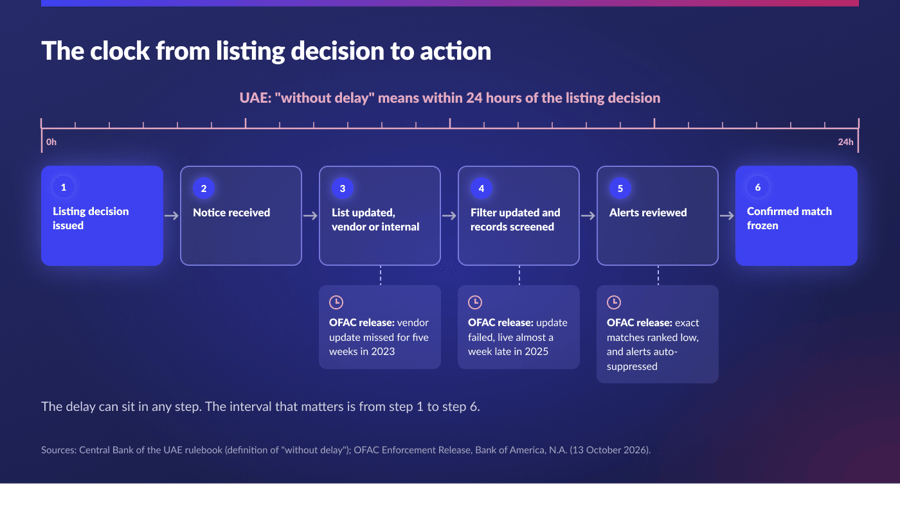
Both failures sit in the interval between a designation and a name being live in the filter. That interval can be measured, and it is the number the UAE's 24-hour rule puts under a deadline.
Half two: the logic that matches names
Match logic decides which differences between two names still count as a match. Wolfsberg defines fuzzy matching as an algorithm-based technique for names that are not identical but are a close match in spelling, pattern or sound. It treats the choice between exact and fuzzy matching as a decision made list by list, alongside which data attributes to screen and when.
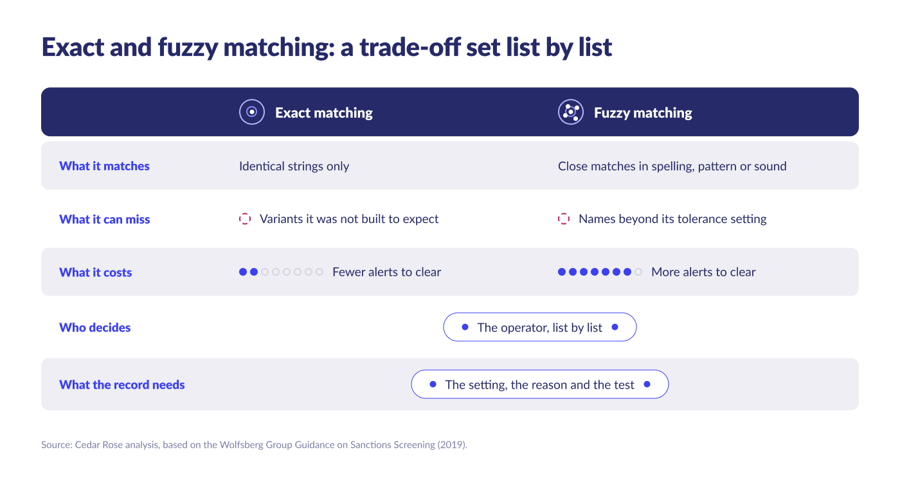
The trade-off is direct. A looser filter catches more variants and raises more alerts for analysts to clear. A tighter filter raises fewer alerts and can miss variants it was not built to expect. Wolfsberg describes no setting as better or worse in itself. It expects the institution to document how its system is configured, to show that the configuration can reasonably be expected to detect the risks it faces, and to be transparent about what the controls are not designed to detect. The decision on how exact or fuzzy to be has to be clearly governed, documented and supported by analysis and testing.
Attributes matter as much as algorithms. Names are the relevant data for list-based programmes, while addresses matter for geographic programmes and also help tell a true match from a false one. Date of birth is a distinguishing factor, and Wolfsberg suggests weighing the value of screening a data element against the reliability of the data. It separates screening data from identifying information: details such as date of birth and nationality on a list entry are there to help assess an alert and do not need to be screened. And it says it is neither expected nor typically productive to screen weak aliases, the broad or generic names such as nicknames and common acronyms.
Names also cross scripts. Wolfsberg lists support for data in non-Latin characters among the risk considerations when choosing screening technology, and foreign-language name variations among the enrichments a list should carry. How those variations behave is covered in our piece on PEP screening gaps, and the same issue applies to media screening in our adverse media article.
Ranking is part of the logic. OFAC's release describes a design flaw in the bank's alert-prioritisation logic that classified alerts as low or medium priority when an individual customer's name and date of birth both matched exactly those of a blocked person. The flaw stayed in place for an extended period. Because those alerts were not treated as high priority, review was delayed, and three designated individuals made 31 transactions totalling $56,258 using their accounts between September 2021 and February 2024. The bank corrected the logic in February 2024, six months after the issue was first identified. Match logic covers how an alert is ranked as well as whether it fires.
False positives: how alerts are closed
Alerts that are not true matches are the daily workload of any screening team, and the rules that manage them are where programmes take their riskiest design choices. Wolfsberg describes the main tools. Suppression rules or good-guy lists remove common false positives that need no manual review. Exclusions leave a low-risk party out of screening. Whitelisting automatically clears hits created by a list term interacting with frequently seen data, for example customer names already confirmed as false positives. It expects the rationale for each rule and threshold to sit in a governance framework, and expects the alert screen to show reviewers all relevant data and let them record their reasoning.
OFAC's release shows the same tools failing. One of the causes it names for payments processed through blocked banks was an alert suppression rule that automatically released alerts based on the same criteria as an alert an analyst had manually dispositioned as a false positive in the past. A past decision on one payment became a standing instruction for later ones. Another cause was analysts approving alerts as false positives by human error.
A further case concerns ownership. In May 2023 an analyst dismissed an alert on an individual recently designated, whom the alert identified as the beneficial owner of a business. The dismissal was a human error, and the business's account stayed unrestricted although the business was blocked. The bank identified the problem about 14 months after the designation, delayed by a surge of alerts after it rescreened all customer records during a move to a new screening platform for which it was insufficiently prepared. The alert reached the business through its beneficial owner, so resolving it depended on seeing who owns and controls the account holder, not only the account holder's name.
In the UAE the outcome of an alert has legal consequences in each direction. The Central Bank's guidance requires licensed institutions to freeze or suspend on a confirmed or potential match and to report within five business days. The Executive Office guidance, as summarised by RegLex, adds that a partial match on an existing customer means suspension without delay until the Executive Office responds, while a false match is not reported but has to be documented. An unresolved alert is therefore not a neutral state. It is either a suspended customer or an undocumented decision.
The control over the controls: testing
Testing is how the two halves are held together. Wolfsberg calls for independent, risk-based testing to confirm that the application generates the alerts expected and that thresholds and rules that suppress alerts operate within risk appetite, and for review of the accuracy and completeness of the data used. Testing can sit with internal audit, an independent compliance group, a vendor engaged for the purpose or a combination, and the results go to the team with primary responsibility for sanctions compliance, which decides whether to accept the risk or remediate.
OFAC's compliance considerations in the Bank of America release read as a testing brief. Decisions on alert parameters and rules should be risk-based, adequately supervised and subject to audit and testing, so that errors do not compound. Technical solutions, including screening software, have to be effective and up to date, and each organisation remains responsible for its own compliance whether or not it relies on a provider. Changes such as a move to a new screening tool should be implemented in a controlled way, to avoid delays, gaps or backlogs that cannot be managed. And recurring violations of a similar kind can raise doubts about the effectiveness of the whole programme.
Each failure described above is the kind a test is designed to find. A timed test of the interval from designation to live filter targets late updates. A set of known name variants run through the filter shows how the logic behaves. A review of what the suppression rules close tests the standing releases. A sample of closed alerts tests the dismissals. Those tests are the programme operator's to design and to document.
Conclusion: two halves, one record
The UAE's 24-hour definition makes the first point in one line: the list is the first control, and it runs on a clock. The OFAC release makes the second: a current list does not help if the logic ranks an exact match as low priority or a rule releases the alert. A sanctions screening programme is defensible when the operator can show the list, the logic, the closing rules and the tests, with the reasons for each choice.
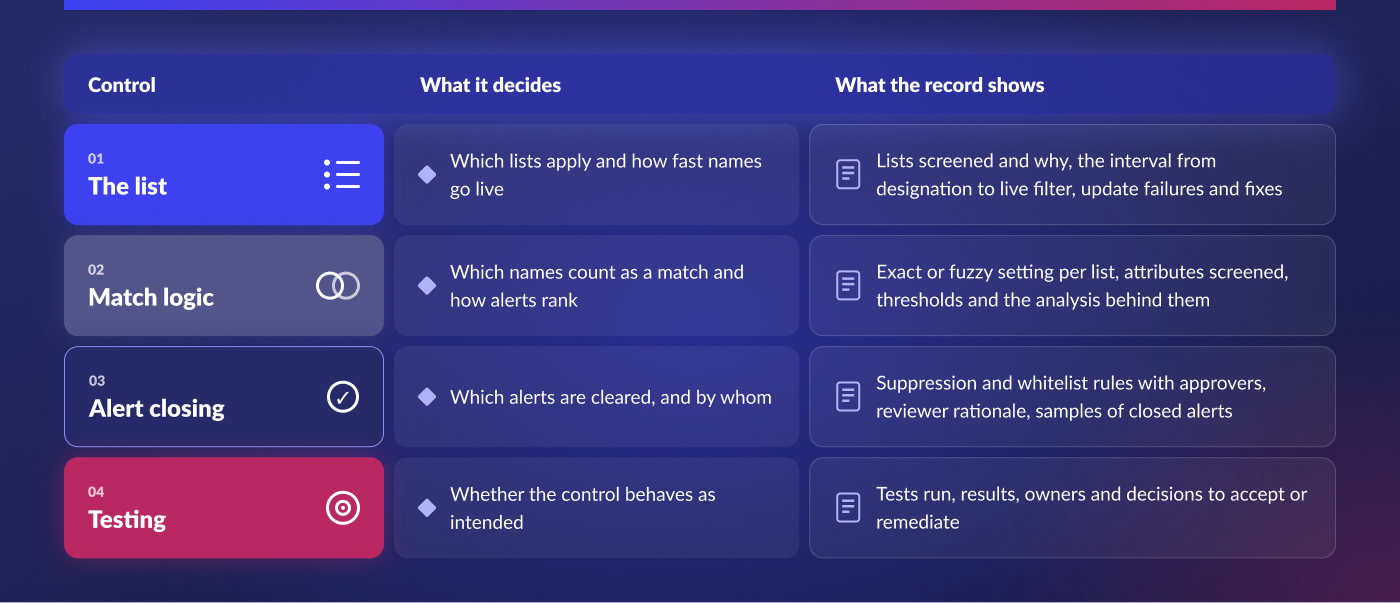
The answers belong to the programme operator. What informs them is evidence that sits outside the screening engine: who owns and controls the entity behind a name, how names are written across markets, and which hits survive human review. That regional evidence layer is where Cedar Rose focuses its compliance and AML screening for programmes working with MEA markets.
Sources & References
- The Wolfsberg Group – Guidance on Sanctions Screening (2019). https://wolfsberg-group.org/resources/202/53
- Office of Foreign Assets Control – Enforcement Release: Bank of America, N.A. Settles with OFAC for $11,662,930 (2026). https://ofac.treasury.gov/media/937231/download
- U.S. Department of the Treasury – Treasury Announces Record Enforcement Actions Against Bank of America (2026). https://home.treasury.gov/news/press-releases/sb0657
- Central Bank of the UAE – Targeted Financial Sanctions (guidance for licensed financial institutions). https://www.centralbank.ae/en/our-operations/anti-money-laundering-aml/targeted-financial-sanctions/
- Central Bank of the UAE Rulebook – Sanctions Obligations and Freezing Without Delay. https://rulebook.centralbank.ae/en/entiresection/603
- RegLex Global Consulting – EOCN's updated sanctions guidance: what changed in March 2026 and what UAE firms must do (2026). https://rlgc.ae/eocn-tfs-guidance-march-2026/
- Cedar Rose – PEP Exposure vs. Sanctions Match: Why AI Can't Make the Call (2026). https://www.cedar-rose.com/blog/pep-exposure-vs.-sanctions-match-why-ai-cant-make-the-call