Every time you sell to a business and allow them to pay later, you are taking a risk. You ship goods or deliver services today, and you hope the money arrives on time. Most of the time it does, but when it does not, the damage can be big. Late payments can squeeze your cash. Disputes can waste your team’s time. A single default can wipe out the profit from many good sales. At the same time, your business can also suffer when a key supplier becomes weak and cannot deliver, because delays and quality issues can cost you customers. This is why Credit Risk management is important for companies of all sizes, not only banks.
This guide is written in simple English so anyone can understand it. It answers common questions people search for, such as what credit risk is, what a credit report for a company means, why credit risk reports matter, how credit ratings work, and how to manage risk with new B2B customers. It also explains how Credit control fits into the full picture, why Credit risk monitoring matters, and how Supplier credit risk can affect your business even if your customers pay on time.
To make the ideas easier to understand, you will also see images and graphs. The graphs use real-world logic and simple examples, so you can understand the patterns without needing your private company data.
The full credit journey in one picture
Before we go deep, it helps to see the full journey from the first contact with a customer to the ongoing relationship. Most companies already do parts of this, but the best results come when the whole journey is connected, not broken into silos.
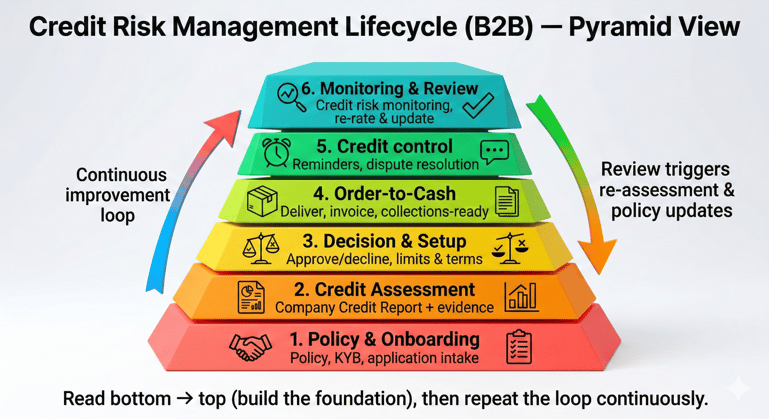
Figure 1 explains credit risk management as a full business cycle rather than a single check at onboarding. The process begins with policy and onboarding, then moves to credit assessment, decision and setup, order-to-cash execution, credit control, and finally monitoring and review. The side loop is important because it shows that monitoring should feed back into reassessment and policy updates as risk changes. Cedar Rose can support this lifecycle most directly at Step 1, Step 2, and Step 6 by helping businesses improve onboarding and KYB, perform structured credit assessment using company intelligence and credit reports, and maintain ongoing monitoring through alerts and regular updates. This joined-up approach helps businesses spot problems earlier, make better decisions, and build safer growth.
What is Credit Risk Management?
Credit risk is the chance that a customer (or any counterparty) will not pay what they owe, on time and in full, under the agreed terms. This risk exists in almost every B2B business that sells on invoice. Credit Risk management is the set of rules, checks, decisions, and daily actions that help you control this risk. It is not only about saying “no.” It is about saying “yes” in a safe way.
Credit Risk management has two big goals. The first goal is to protect cash flow, so your business can pay salaries, suppliers, rent, and taxes without stress. The second goal is to support growth, so sales can win deals while finance stays confident that the company will get paid.
A simple way to think about it is this: you want the right customers, with the right limits, on the right terms, and with the right follow-up. When something changes, you want to notice early and adjust before you lose money.
Understanding credit risk: definition, rating, and key examples
Many people ask, “How do we understand credit risk in real life?” The best way is to look at what usually happens before a big loss. In most cases, there are warning signs. A customer starts paying later. They raise more invoice disputes. They request longer terms, often without a strong reason. Their order size suddenly jumps. They avoid clear communication. None of these signs automatically means the customer will default, but they tell you the risk is rising.
To make risk easy to discuss across teams, companies use a credit risk rating. A rating is a label that shows how risky a customer is, based on available evidence. Some companies use letters like A, B, C, D, E. Others use numbers like 1 to 5. Some use “low, medium, high.” The naming does not matter as much as one thing: everyone in the company must understand what each rating means and what actions follow from it.
A rating should always answer two questions. First, how likely is it that this customer will not pay on time or at all? Second, if they do not pay, how big could the loss be? A customer can be “risky” not only because they are weak, but also because your exposure to them is too large.
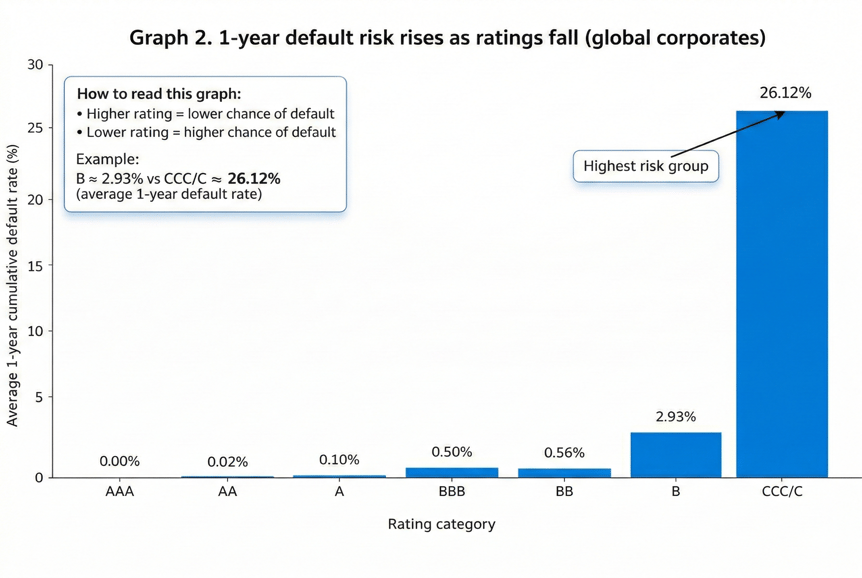
Graph 2 helps the reader understand the meaning of ratings in a simple way: higher ratings generally mean lower default risk, and lower ratings generally mean higher default risk. The jump becomes very clear at the weakest rating levels, which is why companies tighten limits, shorten terms, or ask for deposits when risk increases.
Why businesses should generate credit risk reports
Many businesses wait until there is a problem before they create a credit risk report. That is usually too late. A good credit risk report gives a clear, structured view of a customer or supplier before a large exposure is created. It helps decision-makers move away from guesswork and look at verified facts instead. This improves the quality of decisions and makes it easier for sales, finance, procurement, and leadership to work from the same information.
A buyer usually expects a credit risk report to include a standard set of outputs. These often begin with verified company identifiers, such as the legal company name, registration number, and official status, so the business knows it is dealing with the correct legal entity. A strong report should also include registration and status checks, ownership and UBO information, group structure, and details of key management or directors where available. In many cases, buyers also expect financial or credit indicators, payment-related signals, adverse information, sanctions or PEP screening results where relevant, and a practical recommendation on credit limits or payment terms. Together, these outputs help the buyer understand not only who the company is, but also how much risk may be attached to doing business with it.
Credit risk reports also improve speed and consistency. When the same core checks are gathered in the same format, approvals become faster and easier to compare across customers, suppliers, or markets. This reduces internal disagreement and makes it easier to explain why one company received open terms, another received a lower limit, and another required tighter controls. It also creates a useful record for future review, so if problems appear later, the business can go back and see whether warning signs were missed or whether the exposure decision was too generous. That is how a reporting process becomes a learning tool as well as a risk tool.
What is a Company Credit Report?
A Company Credit Report is a structured document that helps you decide whether to trade with a company and under what conditions. It brings together important information in one place so you can understand the customer’s risk more clearly. In simple terms, it helps you judge whether the company appears real, active, and stable, and whether there are any warning signs that should make you more careful.
A typical Company Credit Report includes verified company identity details, registration status, key corporate information, and a risk view that helps you set limits and terms. It can also help you understand how the company is connected to other companies, whether there are signs of financial or operational weakness, and whether the business looks like a safe partner for trade. In simple words, it answers questions such as: “Who are they?”, “Are they real and active?”, “How are they connected to other companies?”, “What warning signs should we notice?”, and “What do we recommend as a safe starting point?”
A strong Company Credit Report is not only useful for new customers. It can also be valuable for existing customers when your exposure grows, when the market becomes unstable, or when the customer’s behaviour starts to change.
One common misunderstanding is to treat a report like a final verdict. It is not a magic decision. It is a clear summary of evidence that helps your business make a better judgement. You still need to connect that evidence to your planned exposure, your payment terms, and your internal credit policy.
Another misunderstanding is to focus only on financial statements. In many markets, especially with private companies or cross-border trade, full audited financial statements may not be available, may be out of date, or may not be easy to compare. That is why verified corporate data, ownership context, and behavioural signals often matter just as much as financial ratios.
This means a good Company Credit Report does more than describe a business. It helps you understand the real level of risk around trading with that company and supports better decisions before exposure becomes too large.
Company credit risk: what it means and what to look for
Company credit risk is the risk that a business cannot or will not pay under the agreed terms. It includes both ability and willingness. Ability is about cash and resilience. Willingness is about behaviour and culture. Some companies can pay but delay because they manage their cash by pushing suppliers. Other companies want to pay but cannot because cash flow has collapsed.
This is why you should look at the whole picture, not only one score. If you see that a company is active and stable but regularly pays late, the risk might be a willingness problem. If you see that a company is under stress, asking for longer terms, and changing directors often, the risk might be rising ability and stability issues.
A good Company Credit Risk Report helps you see these patterns clearly, especially when the company is in a different country and you do not have local knowledge.
The five components of credit risk analysis, explained in simple terms
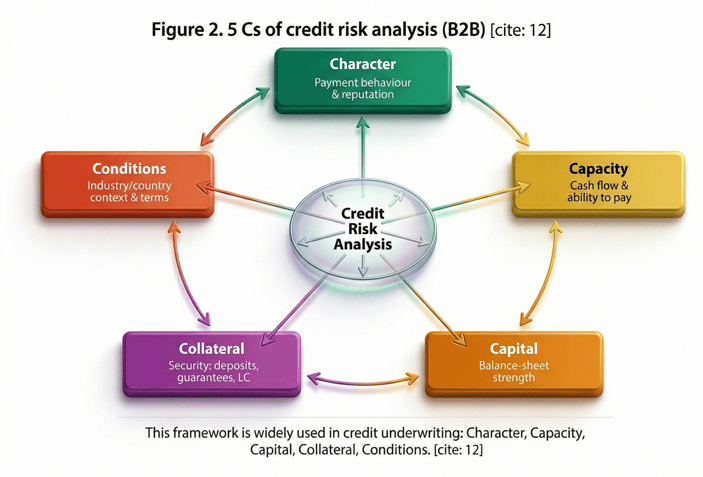
People often ask, “What are the 5 components of credit risk analysis?” A very widely used way to explain this is the 5 Cs of credit. These five parts help you build a complete view instead of relying on only one signal.
Character
Character means the company’s payment behaviour and reputation as a payer. In simple terms, it asks: do they usually pay on time and keep their promises? In B2B, behaviour often becomes a warning sign before a serious financial problem becomes visible.
Capacity
Capacity means the company’s ability to pay from cash flow. This is about whether the business generates enough money through normal operations to pay invoices comfortably, not just “do they look big.”
Capital
Capital means balance sheet strength. A company with stronger capital usually has more ability to absorb shocks. A company with weak capital may struggle if sales drop, costs rise, or key clients leave.
Collateral
Collateral means security. In trade credit, this can show up as deposits, guarantees, letters of credit (LC), or other protections. Collateral becomes more important when uncertainty is high or the exposure is large.
Conditions
Conditions means the external context and the deal context. Industry volatility, country risk, seasonality, and even the payment terms you offer can change the risk level. A company might be acceptable on Net 30 but risky on Net 90.
Company Credit Report as a decision tool, not just a document
To use a Company Credit Report well, you should turn it into a short decision story that anyone can understand. The story should explain what you verified, what the key risk signals are, what controls you will use, and when you will review again. This makes the decision easier to execute and easier to defend later.
For example, if the report shows a company is active and stable but you have limited visibility into ownership, you might approve with a lower starting limit and review after the first payment cycle. If the report shows the company is stable but asks for unusually long terms on a large first order, you might approve only with partial prepayment or milestone billing.
When you work this way, the Company Credit Report supports sales growth without hiding risk.
How to manage credit risk with new B2B customers
New customers are harder because you have less history. The biggest mistake is to treat the first deal like a normal deal. When you do not know a customer’s payment behaviour yet, you should start in a controlled way. This is where Credit Risk management is most valuable, because it gives you a safe path to trade, not only a yes or no.
Before approving a new B2B customer, use a simple checklist:
- Confirm the legal company name
- Verify the registration number
- Check that the company is active
- Validate the registered address and trading name
- Confirm authorised signatories or key contacts
- Review ownership, UBO, and group links
- Screen sanctions and PEP exposure where relevant
- Check for recent director or management changes
- Look for dissolved, struck-off, or inactive history
- Review adverse media or other warning signs
- Confirm correct invoicing and bank details
These checks help you confirm that the business is real, active, and suitable for trade before you create exposure.
The next step is to use a Company Credit Report to reduce uncertainty. For new customers, the report is often more about verified corporate reality and stability signals than about deep payment history. It helps you understand whether the company looks real, active, and consistent, and whether there are signs that suggest higher risk.
Then you structure the first trade. A safe pattern is to start with a modest limit and terms that match the uncertainty level. You can use shorter terms, partial prepayment, deposits on the first order, or staged billing for services. The goal is to avoid creating large exposure before the customer proves they pay as agreed.
This is also where Credit control matters from day one. If invoices are late or inaccurate, you will not learn true payment behaviour. You will only create disputes and delays that make the customer look riskier than they are. Clean invoicing makes the first payment cycle a fair test.
Finally, you should plan an early review. After one or two payment cycles, you can adjust limits and terms based on real behaviour. This creates a clear path to trust, and many good customers accept it because it feels professional and fair.
Credit control: the daily system that turns invoices into cash
Even the best risk decisions fail if execution is weak. Credit control is the daily work that ensures your invoices become cash in a predictable way. In many companies, especially in the UK, Credit control is the name used for this function and its processes.
Credit control starts before an invoice is overdue. It includes making sure invoicing requirements are correct, invoices are sent to the right portal or email, and documents are complete. It includes handling disputes quickly, so they do not block payment. It includes consistent follow-up so late payment does not become a habit.
Good Credit control protects customer relationships because it reduces confusion and frustration. Many customers pay late not because they are dishonest, but because they have internal approval steps and strict invoice rules. If you meet those rules consistently, payment becomes smoother.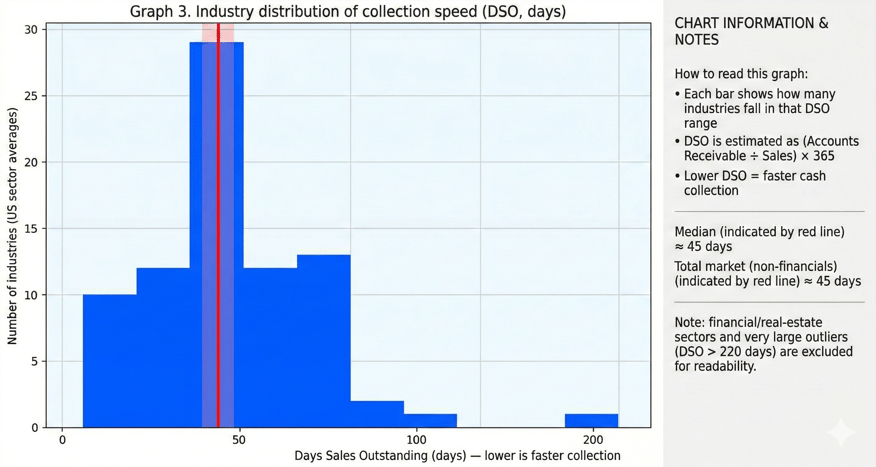
Graph 3 shows that payment speed varies across customers. The goal of strong Credit control is to reduce the “long tail” of very late payers and make cash flow more predictable.
Credit risk monitering: why ongoing checks reduce surprises
Many losses happen because risk changed and nobody noticed early enough. Credit risk monitoring is the habit and system of watching for change signals and reacting before a small problem becomes a large loss. It is not about spying on customers. It is about protecting your business with early warnings.
Common monitoring triggers include:
- Change of legal status
- Inactive, liquidation, or ownership/UBO changes
- Director or management changes
- Significant adverse news
- Sanctions or PEP hits
- Sudden credit score or rating changes
- Payment delays or broken promises to pay
- Frequent disputes or unusual order patterns
These triggers can come from both internal and external sources. Internal signals include payment delays, frequent disputes, broken promises to pay, and unusual ordering behaviour. External signals can include company status changes, ownership changes, management changes, adverse media, or compliance-related alerts. The most important point is that monitoring should lead to action. If your team receives alerts but does nothing, monitoring becomes noise.
When monitoring is done well, it supports better conversations with customers. Instead of waiting until the customer is deeply overdue, you can review the change early, adjust terms or limits, and keep trading in a safer way.
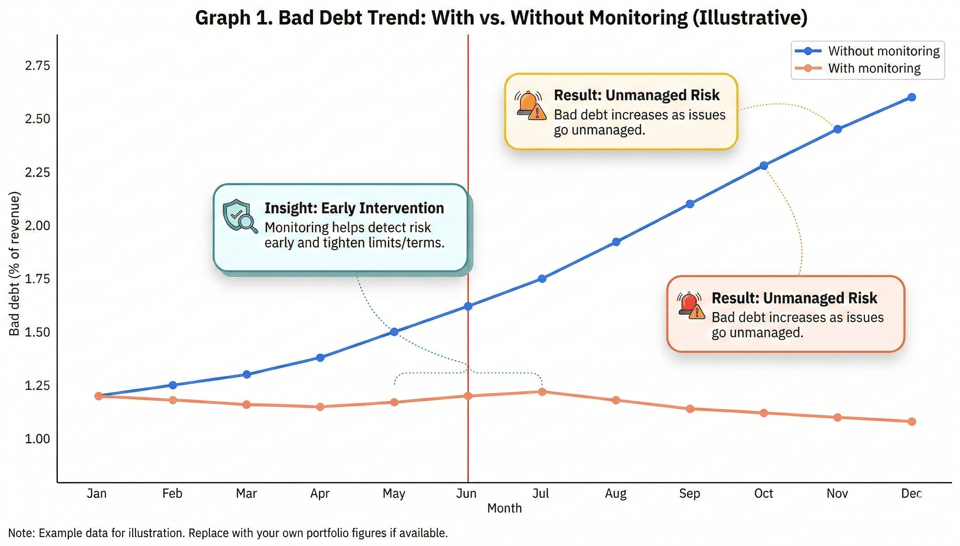
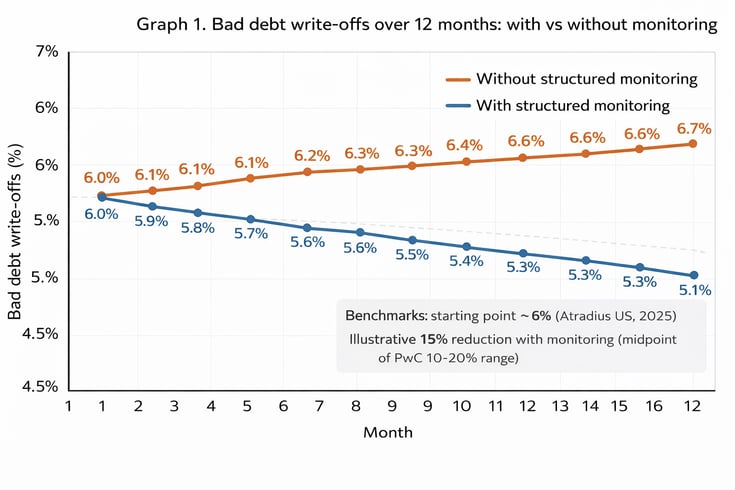
Graph 1 shows a simple idea: structured monitoring usually reduces losses over time because you adjust exposure earlier, before a small issue becomes a big write-off.
Credit risk monitoring and Credit control work best together
Credit risk monitoring becomes far more accurate when Credit control is strong. If invoices are correct and disputes are handled fast, late payment becomes a stronger signal of customer risk. If invoices are messy, you cannot tell whether the customer is risky or whether your own process is causing the delay.
This is why the best teams connect monitoring and execution. When a customer starts to pay later, the team first checks whether there are invoice problems. If invoices are clean, the team treats late payment as a risk signal and adjusts exposure.
This approach protects relationships because it is fair. It also protects cash because it is fast.
Supplier credit risk: why your suppliers can create financial risk too
Many people focus only on customer non-payment, but Supplier credit risk can be just as dangerous. Supplier credit risk is the chance that a supplier will fail to deliver reliably due to financial stress, operational weakness, or instability in ownership and management. When a key supplier fails, you can lose sales, pay for expensive emergency sourcing, miss delivery deadlines, and damage your reputation.
Supplier credit risk is especially important when you depend on a supplier for a critical input, a single-source part, or a time-sensitive service. Even a short disruption can create big costs.
Supplier credit risk often shows up as small changes first. Deliveries become late more often. Quality drops. The supplier starts asking for faster payment or deposits. The supplier changes key contacts or managers often. These patterns do not guarantee collapse, but they signal stress.
(Example: delivery delays + quality issues + payment term changes = higher supplier risk.)
Supplier credit risk and Company Credit Report: a simple improvement many companies
Many businesses use a Company Credit Report for customers, but not for suppliers. That creates a blind spot. If a supplier is critical, you should understand their stability and the risk signals around them. A Company Credit Report can help you see basic status, structure, and warning signs that you might miss otherwise, especially when the supplier is in another country.
Using the same approach for customers and suppliers also improves internal alignment. Finance, procurement, and operations can talk about Supplier credit risk using shared language. That makes decisions faster and less political.
Credit risk monitoring for suppliers: keeping your supply chain stable
Credit risk monitoring is not only for customers. It can also be used to watch critical suppliers. Monitoring helps you see risk earlier so you can act while you still have choices.
For suppliers, monitoring should focus on continuity. You can watch internal performance signals like delivery reliability and quality trends. Where possible, you can also watch external signals that show instability. When a risk signal appears, the point is to choose a practical action, such as adding a second supplier, adjusting inventory levels, or changing payment structure.
When Supplier credit risk is managed this way, procurement becomes proactive instead of reactive, and the business becomes more resilient.
How Credit Risk management creates a safe path to growth
The best Credit Risk management systems do not stop sales. They create a safe way to trade and expand by making decisions consistently and by keeping exposure aligned with evidence.
When the evidence is strong and the relationship is proven, limits and terms can expand. When evidence is weak or behaviour slips, exposure tightens, and terms change. A Company Credit Report helps by making the evidence clear. Credit control helps by making execution clean. Credit risk monitoring helps by detecting change early. Supplier credit risk management helps by protecting continuity so you can deliver and invoice without disruption.
Conclusion: the simplest way to think about credit risk
If you want one simple takeaway, it is this: credit risk is not only about who the customer is. It is also about how much you expose, what terms you offer, how clean your invoicing is, and how early you notice change.
Credit Risk management gives you a system that turns uncertainty into structured decisions. A Company Credit Report gives you a clear base of evidence for those decisions. Credit control turns the decision into real cash by preventing disputes and ensuring consistent follow-up. Credit risk monitoring Management helps you react early when risk changes. Supplier credit risk management protects your supply chain so you can deliver reliably and avoid hidden costs.
When you run these parts as one connected process, you protect profit, protect cash, and make growth safer.
Frequently Asked Questions
1- What is credit risk management?
Credit risk management is the process of checking whether a customer or business partner may fail to pay on time. It helps a company decide who to give credit to, how much credit to offer, and when to monitor the customer more closely.
2- Why is credit risk management important for B2B companies?
B2B companies often sell goods or services before getting paid. If the customer pays late or does not pay at all, it can affect cash flow and business growth. Credit risk management helps reduce this risk before it becomes a serious problem.
3- What is a company credit report?
A company credit report is a report that helps businesses check another company before working with it. It can include company details, registration information, ownership details, payment behaviour, credit risk signals, and other information that supports safer business decisions.
4- How can a business reduce credit risk with new customers?
A business can reduce credit risk by checking the company first, reviewing a company credit report, setting a safe credit limit, agreeing clear payment terms, and monitoring the customer after the first transaction. This helps the business grow without taking unnecessary payment risk.
5- What is credit control and how does it help cash flow?
Credit control is the process of managing invoices, payment terms, follow-ups, and overdue payments. It helps businesses collect money on time, reduce late payments, and protect cash flow. Good credit control works best when it is supported by reliable credit risk data.