
A cross-border risk assessment across six MENA and Eastern Mediterranean jurisdictions surfaces two fundamentally different risk patterns—and conflating them is one of the more common errors in multi-jurisdiction due diligence. Cyprus, Morocco, Oman, Saudi Arabia, Tunisia, and the United Arab Emirates each carry active legal-event exposure, but the shape of that exposure varies sharply by market. Some jurisdictions are seeing insolvency accelerate in real time. Others are sitting on large, comparatively static pools of historical cases. A risk program that applies one monitoring cadence to both is misreading at least one of the two signals. This split is documented in detail in Cedar Rose's Public Notice Intelligence Report 2026, which analysed 58,926 companies with active legal-event flags across these six markets.
Two Ways a Jurisdiction's Risk Profile Can Look Elevated
There are two distinct ways a jurisdiction can register as high-exposure in a legal-event dataset. The first is flow—the rate at which new bankruptcy, liquidation, or litigation cases are being filed right now. A jurisdiction with rising flow is one where financial distress is actively worsening. The second is stock—the cumulative volume of historical cases sitting on record, which may have accumulated over years without necessarily indicating an active, worsening trend today.
This distinction matters operationally. Flow is the leading indicator: it tells a risk team where conditions are deteriorating and where re-screening frequency should increase. Stock is a structural characteristic: it tells a risk team where corporate structuring and holding-entity activity is concentrated, which changes what kind of due diligence—ownership mapping, subsidiary-level checks—is actually useful. Saudi Arabia, Tunisia, and Morocco are this dataset's clearest flow jurisdictions. Cyprus, Oman, and the UAE are its clearest stock jurisdictions.
The Accelerating-Flow Jurisdictions
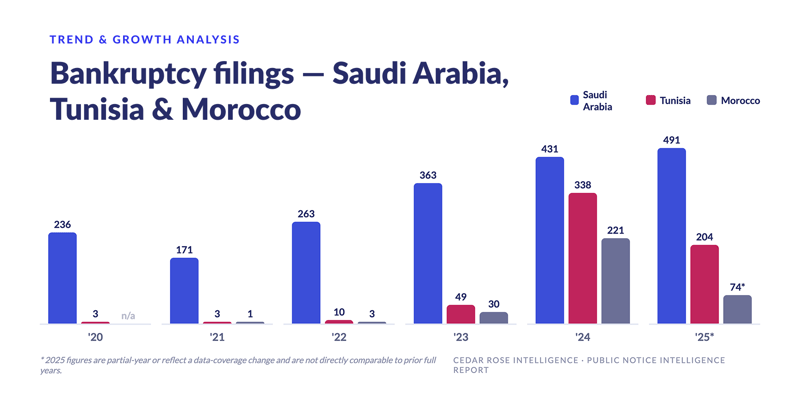
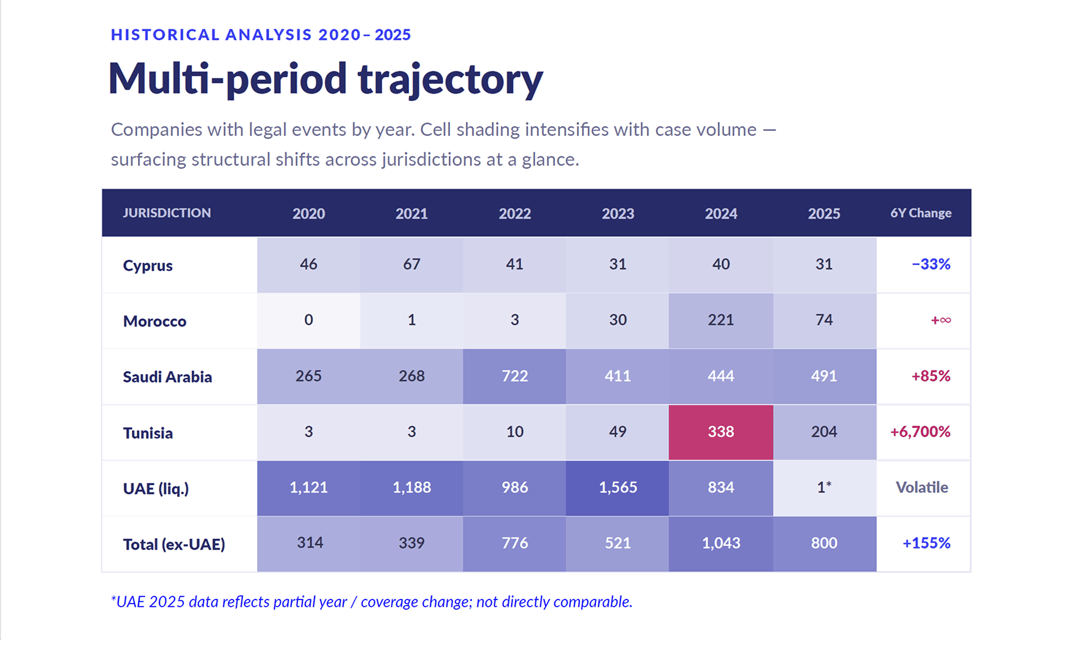
Saudi Arabia generated 393 new legal-event cases in the most recent 12-month observation period—75.3% of all new cases recorded across the monitored region, and the highest volume of any single jurisdiction. Its cumulative legal-event base stands at 1,601 companies, up 85% since 2020. Bankruptcy filings rose from 236 cases in 2020 to 491 in 2025, a 108% increase, though the year-on-year growth rate has moderated—from 54% growth in 2022 to 14% in 2025. That moderation is worth reading carefully: it likely reflects the formal insolvency framework (substantially upgraded under the 2018 Bankruptcy Law) absorbing an initial backlog, rather than distress conditions easing. The sustained absolute growth remains the dominant signal.
Tunisia shows the steepest trajectory in the dataset. Legal-event activity grew 6,700% between 2020 and 2025, driven almost entirely by bankruptcy filings, which rose from 3 cases in 2020 to a peak of 338 in 2024 before moderating to 204 in 2025. Even after that moderation, the 2025 figure sits roughly 68 times above the 2020 baseline. Tunisia's cumulative legal-event base is 532 companies, and—unlike Saudi Arabia or Morocco—every one of those cases is a bankruptcy filing; the dataset records no liquidation or litigation activity in Tunisia at all, suggesting bankruptcy is functioning as the primary formal mechanism through which business distress is being captured there.
Morocco is the earliest stage of the three flow jurisdictions, and its growth curve is the steepest single-year jump in the dataset. From a near-zero baseline of 1 case in 2021, bankruptcy filings rose to 3 in 2022, 30 in 2023, and 221 in 2024—a compound annual growth rate of 120.9% and a 636% jump in 2024 alone. The September 2023 Al Haouz earthquake is a plausible contributing factor, alongside rising financing costs for Moroccan SMEs. New-case activity in the most recent 12-month window (27 cases) suggests some normalisation from the 2024 peak, consistent with the moderation patterns seen in Saudi Arabia and Tunisia. Morocco's cumulative base of 322 companies is the smallest of the three flow jurisdictions, but the trajectory—not the current volume—is what makes it analytically significant: this is a risk cluster still in its early, most actionable stage. The full year-by-year breakdown for all three jurisdictions is available in the report.
The Structural-Stock Jurisdictions
Cyprus holds the largest liquidation stock of any monitored jurisdiction—33,198 companies—and records 1 in 17 registered companies carrying an active legal-distress signal, the highest corporate vulnerability density in the dataset. But the annual flow tells a calmer story: only 13 new cases were recorded in the most recent 12-month window, and the jurisdiction's yearly liquidation volume has held remarkably stable at roughly 58 cases per year going back to 2020. Cyprus's risk profile is not one of accelerating crisis; it is a structural characteristic of a jurisdiction widely used for holding companies, Special Purpose Vehicles, and international business structuring. The large stock reflects that role, not a worsening solvency environment.
Oman holds the second-largest liquidation stock in the dataset at 19,332 companies—and recorded zero new cases in the most recent 12-month observation period, indicating the stock represents historical dissolved entities rather than an active distress flow. The dataset captures only liquidation activity in Oman, with no bankruptcy or litigation cases recorded, which points to a coverage gap in the available data rather than the absence of those event types entirely. What the flow data does make clear is that Oman's risk profile, like Cyprus's, is dominated by cumulative stock rather than current-period acceleration.
The United Arab Emirates presents the most volatile trajectory of any jurisdiction in the dataset. Annual liquidation volumes swung from 1,121 cases in 2020 to a peak of 1,565 in 2023 before falling to 834 in 2024—and then to just 1 recorded case in the most recent 12-month window. That collapse is almost certainly a data-coverage change rather than a genuine market signal; the UAE's standing liquidation stock (3,941 companies) and its historical annual volumes (averaging roughly 1,147 per year between 2020 and 2024) suggest the near-absence of 2025 data warrants verification before being read as a positive development. Risk teams evaluating UAE counterparties should treat the 2025 flow figure as unconfirmed rather than reassuring.
Why the Distinction Matters for Cross-Border Risk Assessment
The practical consequence of this split is that a single monitoring cadence does not serve both jurisdiction types well. In the flow jurisdictions—Saudi Arabia, Tunisia, and Morocco—the risk that matters most is what changes next. A counterparty that looked clean six months ago may not look clean today, particularly in Tunisia and Morocco, where historical due diligence has a materially higher probability of being outdated given the pace of change. These jurisdictions justify quarterly, not annual, review cycles.
In the stock jurisdictions—Cyprus, Oman, and the UAE—the risk that matters most is what's connected to what. A single operating entity may look unremarkable in isolation while sitting inside a corporate structure that includes a liquidating holding company or a dormant shell entity elsewhere in the same jurisdiction. This is a different due diligence problem than flow risk—it calls for structural and ownership-level analysis rather than simply monitoring for new filings, since new filings in these jurisdictions are comparatively rare to begin with.
Neither pattern is inherently more dangerous than the other—they represent different risk mechanisms, and a cross-border risk assessment framework needs to account for both rather than defaulting to a single screening model across all six markets. Where the two patterns genuinely compound each other is at the network level, when a distressed entity in a flow jurisdiction shares directors or ownership with entities in a stock jurisdiction—a dynamic worth examining on its own terms.
Conclusion
Cross-border risk assessment across these six jurisdictions only works if it accounts for the fact that "elevated risk" means two different things depending on the market. Saudi Arabia, Tunisia, and Morocco are jurisdictions in active transition, where new-case volumes are climbing and where re-screening frequency should reflect that pace of change. Cyprus, Oman, and the UAE carry large historical case volumes that speak more to their role in regional corporate structuring than to a worsening solvency environment today—the risk there sits in what those entities are connected to, not in how many new filings appear each quarter. Applying a single monitoring model across all six markets means either over-monitoring stable jurisdictions or under-monitoring the ones where conditions are genuinely deteriorating. The data supports treating this as two distinct risk problems, not one regional average.
Sources & References
- Cedar Rose – Public Notice Intelligence Report 2026
.png?width=352&name=article%20banner%20website%20(1).png)