
Public notices reveal financial distress, structural corporate change, and jurisdiction-level risk dynamics — often months before those same developments surface in credit ratings, audited financials, or regulatory enforcement actions. That is their core value as a source of early warning risk signals, and it is a value most compliance and risk functions are not yet capturing.
Bankruptcy filings, liquidation proceedings, court actions, company deregistration, and directorship changes are legally mandated disclosures. They are published by courts, commercial registries, and regulatory authorities, and by design, they are public. Yet across compliance functions, they are typically treated as administrative footnotes — records to file once a counterparty's status changes, not signals to act on before it does. That gap between how public notices are generated and how they are used is worth examining closely, because it has direct implications for how organizations manage third party risk monitoring and counterparty exposure.
Public Notices Are Legally Mandated Disclosures — Not Just Court Records
Public notices include, but are not limited to:
- Bankruptcy and insolvency filings
- Liquidation and dissolution proceedings
- Court actions and litigation records
- Company deregistration and strike-off
- Regulatory enforcement actions
- Ownership, directorship, and structural changes

Individually, a single filing tells a narrow story: one company, one event, one point in time. That is likely why most organisations engage with public notices reactively — a compliance team checks a registry when onboarding a new counterparty, or a court filing surfaces during a periodic review. Used this way, public notices function as a record-keeping input, not a risk intelligence source.
The distinction matters. Record-keeping answers the question, "What happened?" Risk intelligence answers the question, "What is likely to happen next, and to whom else?" Public notices are capable of answering both—but only the second use case delivers early warning value.

From Administrative Record to Predictive Instrument
The shift from record to signal happens at scale. When public notices are aggregated, cross-referenced, and analysed across time horizons and jurisdictions rather than reviewed one filing at a time, they behave differently. Patterns emerge that are invisible in any single record: which sectors are generating a disproportionate share of new legal events, which jurisdictions are seeing acceleration versus stabilisation, and which counterparties sit inside networks where one company's distress signals exposure for others.
This is the basis for treating public notices as predictive instruments rather than administrative records. A recent analysis spanning six jurisdictions—Cyprus, Morocco, Oman, Saudi Arabia, Tunisia, and the United Arab Emirates — examined 58,926 companies carrying active legal-event flags across three event types: bankruptcy, liquidation and dissolution, and litigation and legal procedures. At that scale, the data stops functioning as a set of individual court records and starts functioning as a live map of where financial distress and structural corporate change are concentrated across a region. The full six-jurisdiction breakdown, including which markets are accelerating and which are structurally exposed, is available in the Public Notice Intelligence Report 2026.
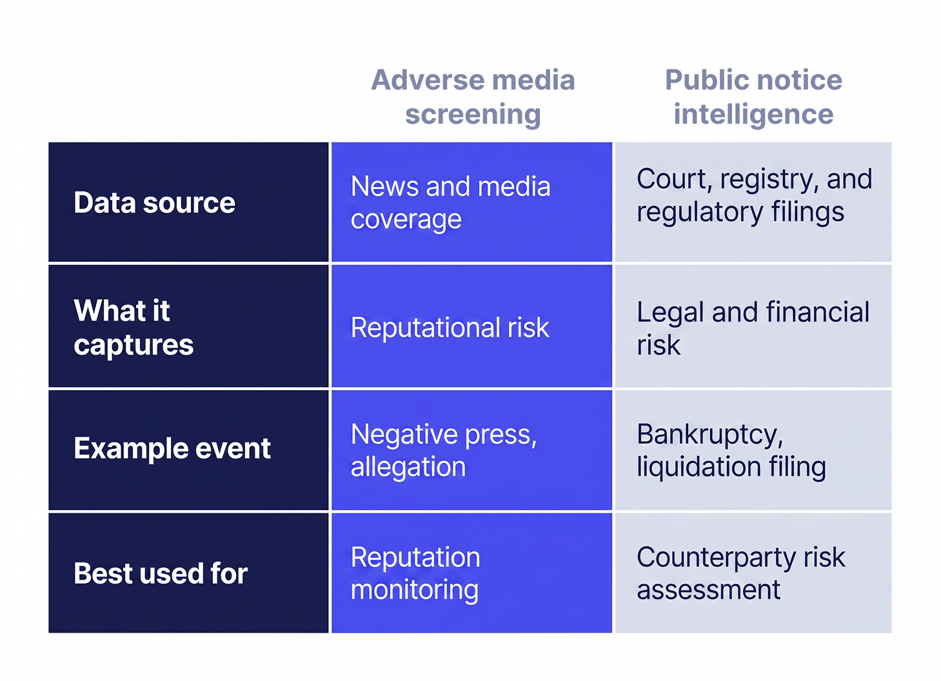
This is precisely where public notice intelligence earns its distinction from adjacent risk data categories. Adverse media screening, for example, surfaces reputational risk—negative press coverage, allegations, and controversy. It is a valuable and widely used input into a risk program, but it captures a different kind of exposure. Public notice intelligence captures legal and financial risk directly from the regulatory record itself: a bankruptcy filing or a liquidation proceeding is not an allegation or a media narrative; it is a legally documented event. The two data sources are complementary, not interchangeable, and an organisation relying on one without the other has an incomplete picture.
Why Static Screening Misses the Signal
.png?width=772&height=488&name=img%204%20(1).png)
Most compliance programs are still built around static, point-in-time screening: a counterparty is checked at onboarding and re-checked on a fixed schedule—annually, in many cases. Public notices, however, are generated continuously, and the risk-relevant information they carry does not wait for a scheduled review cycle. A bankruptcy filing that occurs eight months after onboarding will not surface until the next periodic check, if at all.
This is the operational argument for continuous compliance monitoring over static screening. It is not simply that continuous monitoring is more thorough—it is that the underlying data source (public notices) is itself continuous and time-sensitive. A framework built around periodic checkpoints is structurally mismatched to a data source that updates in real time. For organisations conducting proactive due diligence on counterparties in emerging or fast-changing markets, that mismatch is where exposure accumulates unnoticed.
The practical implication for counterparty risk assessment is straightforward: entity status is not fixed at the point of onboarding, and treating it as fixed is a design flaw in the screening process, not a data limitation. The information needed to catch a change in status usually already exists in the public record—the gap is in how consistently and systematically that record is monitored.
From Signal to Strategy
None of this requires new data. Public notices are, by definition, public. What it requires is a shift in how that data is used — from a reference checked occasionally to a signal monitored continuoused—from a single-entity lens to a network-aware one that accounts for how one counterparty's legal status can carry implications for others connected to it. Organisations that make this shift are better positioned to identify financial distress and structural risk before it appears anywhere else in their risk stack—not because they have access to different information, but because they are reading the same information differently.
Conclusion
Public notices are not a niche compliance data source—they are a continuously updating, publicly available record of financial distress and corporate change. The organisations extracting the most value from them are not the ones with access to different data; they are the ones that have moved from treating public notices as an administrative checkpoint to monitoring them as an early warning system. That shift—from static, point-in-time screening to continuous, network-aware monitoring—is becoming a baseline expectation for compliance and risk functions operating in fast-changing markets, not a differentiator reserved for the most sophisticated teams.
Sources & References
- Cedar Rose – Public Notice Intelligence Report 2026
.png?width=352&name=flow%20stock%20website%20(1).png)
.png?width=352&name=website%20img%20(1).png)